
Silambam — the Murugan-Agastya Dhanurved
On the Warrior art of the Chola, Pandya and Pallava RajVansh
6 sectionsabout 35 min read
Pick up a सिलम्बम् कम्बु and the first thing you learn is that it is not just another random stick.
It has a weight and a balance that a cut length of bamboo does not have. It is chosen and seasoned deliberately — a straight, uniform cane or bamboo of a particular heft, cut, treated with oils, shaped and hardened over fire, and then tested by striking it on the surface of still or running water. The sound and recoil tell the Asan what a measurement cannot. The kambu is selected the way a musical instrument is selected.
That one detail tells you what kind of vidyā Silambam is. A practice does not arrive at such a test casually. It does so because generations of gurus have observed the cane, the hand, the water and the strike, and have preserved what works.
Silambam is the Chola-Pandya stream of Dhanurveda as expounded by Agastya Maharshi and his Siddha disciples. Its representative weapon is the Nedu Kambu, the great staff derived from the classical Vel of Vel-Murugan Karthikeya Swami. It is not random lessons scattered here and there, not a gimmick and not a one-off invention. It is a continuous knowledge-system extending across immense reaches of kāla and deśa. It exchanged with the many lands ruled by the Chola and Pandya houses, receiving and giving through every encounter, yet never surrendering its own svarūpa.
It carries a thousand styles, differing by Asan, community and place, and remains coherently one—not despite that multiplicity, but through it. One Asan may begin where another ends; one community living in Kurinji mountains develops as per their ecology, environment and battle strategy in that geography, one paramparā may count, name or arrange a sutru differently from the next; the same movement may cross a hill, river or language and return under another name & form. To the eye looking from outside, this can appear distributed, chaotic, contradictory and esoteric. To the shishya who has entered through guru-paramparā, the foot finds the same ground, the force follows a familiar path and the apparent contradictions reveal different decisions made within one grammar.
Silambam is practical enough to stop an attack and transcendental enough to become worship; simple enough to place in a child's hands and deep enough to spend multiple lifetimes and still be learning.
Like Bharat, it is bewildering when reduced to a diagram and completely natural when lived from within. What appears impossible to organise from outside becomes, from inside, coherent, easy and finally the only way the movement could have been. It is one of the most beautiful expressions of the great river called धनुर्वेद.
Let us follow that stream — to the halls it was kept in, and the tree still standing with its root cut; to Mahadeva, Agastya and Murugan, and to the Devī whose own Vel began it; to the strike the Agnipurana names and the stances it measures in the span of your own hand; to the animal forms in which a body tells Itihāsa; to the order in which that body is built, from the first squat to the १०८ वर्म points; and to how far this vidyā travelled — as far as Karate, as far as a Celtic belt-plate in a Vienna museum — before we come to what, in the end, it gives. This is not just the story of Silambam or Dhanurveda, but the story of Bharat, of whole mankind, of Dharma and how it stands tall after timeless ups and downs.
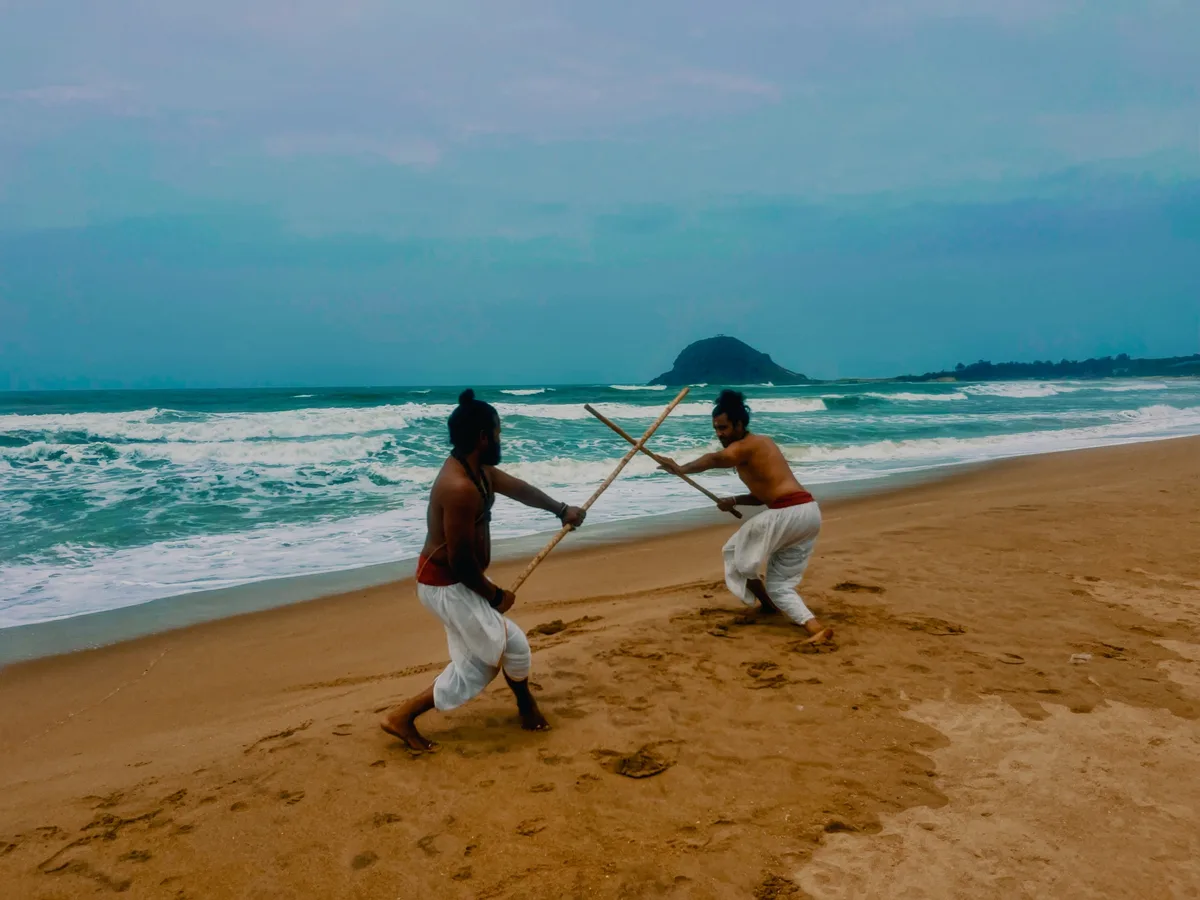
A tree of many branches, standing without its root
In the sixteenth century, Paranjothi Munivar, composing the Thiruvilayadal Puranam, described not only the art but the kshetra (place) in which it was practised — the सिलम्बकूडम्.
The Tamil encyclopaedia Kalai Kalanjiyam, in the passage quoted by A. Arunachalam Master in Silambam: An Indian Ancient Martial Art (2021), remembers this as a mature staff-defence art: the Silambakoodam is not a modern label placed on an old practice, but the living kshetra in which its people met and trained in kshatriye (warrior) arts.
Silambam fencing, or Kolu Vilayattu, was practiced in ancient Gymnasium[s] called Garadi Koodam in Andhra Pradesh. Silambam is called kalari in present-day Kerala (a state of Bharat with great contribution to Sanatan Dharma). 'Kalari' means 'silambamkoodam', or open space specially set apart for training martial arts. 'Payat' means teaching or instructing martial arts through specific exercises. Hence kalari payat means teaching of martial arts. — A. Arunachalam, Silambam, quoting Dr. David Manvel
A koodam is a hall. The Silambakoodam is the hall in which the whole Silambam vidyā is taught. Travel north and west and the same institution continues under the local tongue: the गरडि माने of Karnataka, the गरडि कूडम् of Andhra, the कलरि of Kerala, and the अखाड़ा farther north and west. The arts themselves bear their own names — Paika Akhada in Odisha, Mardani Khel in Maharashtra, Sothi in Punjab — because languages, lands and guru-paramparās differ:
Staff Fencing [is] being practiced in almost all regions of this vast democratic country, India. In Maharashtra state, staff fencing is popularly known as 'Lathi', whereas the same is called 'Dhal Lakadi' in Gujarat state, 'Karra Saamu' in Andhra state, 'Lati Lakadi' in Bengal state, 'Dhanta Varisai' in Mysore state, 'Nedu vadi' [in] Kerala state, and Silambam in Tamil Nadu state. — A. Arunachalam, Silambam, quoting Dr. David Manvel
Many names from the Himalaya to Kanyakumari, many highly developed local styles, and one Bharatiya tree. In the Dakshin its longest and most luxuriant branch grows in the country whose iṣṭa-deva, Vel Murugan Swamy, carries the Vel as his own primary āyudha.
The branch did not stay. Wherever the Chola, Pandya and Pallava houses carried Sanatana Dharma, its arts were taken up with everything else — and they are trained today under other names: Karate, Kung-fu, Muay Thai, Silat, Angampora. A branch grows where it grows. Its leaves take the shape of that weather, its wood the lean of that light, and the birds in it are that country's birds — a tree of one branch would be a poor tree. But no branch feeds itself, and neither does the tree; both drink from the same root, and there is nothing in that for either of them to mind. The eye that cannot see this is the same eye that severs the Buddha from Shri Nārāyaṇa, though the Buddha, asked who he was, answered आदिच्चा नाम गोत्तेन — by clan, of the Sun — and named himself of the Ikṣvāku line, the Sūrya Vaṃśa of Shri Rama. So the question stands: how is it that there is a studio teaching Karate on the next street, and a fascination in us with becoming a Kung-fu fighter or a Ninja one day, and no place — in the city or in ourselves — where our own art is trained? The answer is layered. It begins here, and runs through the rest of this article.
The akhara in a village of Uttar Pradesh and the Karra Saamu ground in a village of Andhra were still working grounds for some years after 1947. Go back to our great-grandfathers and great-grandmothers: every one of them carried a long staff and knew how to use it, handling the musal was ordinary work, and all of them knew that their own defence and the upholding of their Dharma was their own responsibility — not something to be settled in an inquiry after the damage is done.
That is why Bharat was never enslaved, not for a single moment. Every invader learnt to keep a balance — the Islamic, and the Portuguese, French and British missionaries after them — because an Alluri Sitarama Raju, a Rampyari Gurjar, a Gokula Jat could rise from any corner of the country at any hour. Jalaluddin Akbar could rule only with a Man Singh in his army, who still wore his tilak with pride. The British needed a MohanDas K. Gandhi, who could persuade people not to be agitated and could quietly turn a warrior's identity into a false ahimsa. They had not taken the land from a defeated people either: they took it from the Marathas, and on the day they left, most of it was still governed by the princely states under rules drawn from Dharmaśāstra. Even where they ruled directly they moved by persuasion and by law rather than by open confrontation — and the wars they fought abroad, the ones they named World Wars, were carried for them by the Indian Army, the largest volunteer force ever raised anywhere.
Temples were demolished and conversions forced in phases, and every phase was met with a disproportionate outburst. The uprooting tactics kept changing, and every one of them failed. A warrior in every village made the attempt too costly, and its repercussions were more than any invader could bear. The resistance was always on.
The European Nord and the Viking warriors were uprooted, and survive as material for cosplay; what remained was burnt in the witch-hunts. The Pahlavas of Parsik desha converted. Africa converted. The native peoples of the Americas and the Māori of New Zealand went off the map altogether, cut off from their ancient memory and their Devatas. It was always the made-up cults against the indigenous, and we are the only ones still standing, the only Sanatani who see divinity in Nature and worship their ancestors — because our warrior tradition never stopped being practised.
Then it was taken without an army. From 1947 onward the fading ran faster than under any invader — the Gurukulam devalued, the akhara emptied, the physical culture dethroned, all through a planned subversion of thought. Our own picture of ourselves was rewritten with it: the Bharatiya physical culture was reduced to the passive, peaceful yogi and nothing more. Not the warrior. Not Arjuna, dynamic in life and pursuing all four पुरुषार्थ for the sake of Dharma — which is what our ancestors actually were.
Our Dharma-Shastra holds दण्डनीति — whose principal aṅga is Dhanurveda — to be the one vidyā at the base of all the rest, because every other vidyā, आन्वीक्षिकी and the त्रयी included, depends upon it (कौटिल्य अर्थशास्त्र १.२; शुक्रनीति). Every Devi and Devata in every sculpture holds an āyudha; every account in our itihāsa turns on courage. The root of every warrior practice on earth is here — and its own people now take their fighting arts and physical sports from east and west as followers, keeping to rules, Darshana and a pedagogy set elsewhere. Bharat was never enslaved by any invader. In its own physical culture it has volunteered.
So the akhara is a rare sight, while gyms have sprung up everywhere like mushrooms and the choice left on offer is Zumba or aerobics. Paika Akhada survives as a few demonstrations. Pandav Khel is danced in Uttarakhand with the āyudha carried as relics, by the descendants of Rani Karnavati, who cut the noses of the invaders with that same āyudha. A few moves survive here and there; the system does not. Every village and every community once had its own style, and most of us cannot name the art that belonged to our own place, let alone move in it. What is sold back to us instead is protein shakes, body-shaming and our own physical arts under other names. People now try to climb out of this with the very vocabulary that put our arts down — western reductionist pedagogy and modern terms, learning the art while erasing its root entirely — and that is bound to fail.
A great deal of what was lost is still waiting to be reclaimed. Silambam is the exception. The pedagogy, the practice, the practicality and the community are all intact, in all their variety — there are children of five and an Amma in her sixties taking the kambu in their hands every week in our own akhara. K. Pajanivel Asan, from the same village our practice comes from, has just received the Padma Shri. Devalued at home by the colonised mind, the art still draws students from across the world to those Asans who have managed to reach outward.
Swami Vivekananda told Sister Nivedita that if she would do one thing in the service of Maa Bharati, it should be this: every corner of this bhoomi has its own art form — learn it, and bring it back to its glory. The Dhanurveda Kalā of every region is making that same call. In a world where fitness is on everybody's mind, why not use the pedagogy and the systems that were time-tested by our own ancestors? That vow is not taken in words. It is taken by picking up the āyudha and the kambu, entering a guru-paramparā, and carrying the art forward with full authenticity.
The name is the representative, not the whole
धनुर्वेद is not merely धनुर्-विद्या. In its bṛhat meaning it is not confined to the bow. Its own chapters contain the पाश and खड्ग, लगुड and गदा, मुसल, परशु and तोमर. They also contain बाहुयुद्ध, the unarmed body, counted as a complete division beside the weapons. The bow lends the vidyā its name because it is the representative āyudha; it does not exhaust the vidyā.
Silambam is formed on the same principle. The नेडु कम्बु is its representative āyudha but colloquially now termed Silambam. The other weapons such as Gada, Podi-kuchi (short sticks), Vel, Vaal, the नियुद्ध (bare hand) and the श्रम-अभ्यास that builds the practitioner all live inside the name. Silambakoodam is not the hall of one staff. It is the place where the entire practice unfolds.
One āyudha can stand for the rest because the same movement-grammar runs through them: the same निलई, the same काल पाडम footwork, the same turning of the waist and shoulders, the same rotational paths for generating and receiving force. This is why the kambu that enters a beginner's hands early teaches the flow of every other āyudha just as aptly.
It works as music does. A khadga does not resemble a kambu, and the empty hand holds no weapon at all; yet the trained body recognises the same sentence passing through each. The seven स्वर remain the same whichever instrument one takes up, and tāla remains tāla. The modality changes with the instrument; the music does not. The āyudha can disappear and the grammar still speaks.
Who taught it: Murugan, Agastya and the Dhanurveda gurus
Mahadeva is the Ādiguru of Dhanurveda. The vidyā coming from Shiva is taught through the great lines of विश्वामित्र, वसिष्ठ, जमदग्नि and परशुराम, अगस्त्य, भरद्वाज and द्रोण. The formless Shiva takes many forms, and his vidyā manifests with the distinct beauty of each guru-paramparā.
Agastya Maharshi and Bhagavan Parashurama established the great southern streams. Vel Murugan Swamy, Mahadeva's own son and Devasenapati, is the guru and supreme practitioner of Silambam. Agastya carried the vidyā through his Siddha disciples; Murugan gave its warrior-form, its Vel and its living centre. Their lines are not ornamental names attached afterwards. They explain why Silambam joins āyudha, niyuddha, prāṇa, marma, medicine, mantra and worship within a single discipline. Vashishtha, Vishwamitra and Agastya Maharishi all guided Shri Ram in Ayudh, Niyudh and Dharmashastra. Bhagwan Parashuram was the Guru of warriors like Bhishma Pitamah. It is the same vidya the same Vel that Maharana Pratap sitting on his Chetak raised bravely at Islamic Invaders and protected Dharma, the same rotational moves with which Maratha wielded their DandPatta to protect this Dharm Bhoomi from barbarians, the same Pichua in silambam art that Guru Gobind Sigh ji asked every Sanatani Hindu who is ready to fight for Dharma to keep, the same tactics of Silambam and Vel that Marutha Bandhu, Kumili and the Velu-Nachiyar protected the lands of Shivagangai from cunning missionary and plunderers of west, the Mudgar that Dushyant Maharaj carried in all glory is the same Karlakattai that forms the basis of strength & conditioning in Silambam and of all the Mallayudha enthusiasts across the lands of Bharat and Beyond, the same musal or Karlakattai that Gopa-Gwale used against the Duryodhana army in Virat Yudha was again used by the brave lady Onake Obavva in the same manner to kill the Adham in Kaliyuga. The Dhanurved and the Dharma Shastra span the large lands of Dharma and vast spans of many Yuga.
That line has not ended in itihāsa. Our own paramparā remembers eighteen names, and it is from that line — hand to hand, Asan to shishya — that we received what we teach. It stands on a floor today, in the Asans who practise Marma at its highest reaches and beyond it, who received the vidyā from their own Asan exactly as it was given and who will hand it on the same way. A paramparā is not a list of names behind us. It is the person standing in front of the shishya.
When śastra meets śāstra: Vettu and the Dhanurveda text
The Agnipurana, in its chapter on the लगुड — the daṇḍa or staff — gives the decisive strike in two verses:
करेणादाय लगुडं दक्षिणाङ्गुलकं नवम् । उद्याम्य घातयेद् यस्य नाशस्तेन शिशोर्दृढम् ॥ ११ ॥ उभाभ्यां सहस्ताभ्यां कुर्यात् तस्य निपातनम् ॥ १२ ॥
— अग्निपुराण २५१.११–१२
Udyāmya — the laguda rises. One hand learns its path; both hands gather and bring it down. On the Silambam floor the same raised, straight, descending blow is वेट्टु, the hard hit; at the head it is तलै-वेट्टु. It is the principal lethal strike of the Silambam art, and it is still taught with the fervour the Agni-Purāṇa describes, and by the same method: receive it from the Guru, then make it powerful through countless repetitions.
The same Dhanurveda section discusses stances / sthan or asan before it teaches the Ayudh and Niyudh:
बाह्याङ्गुलिस्थितौ पादौ स्तब्धजानुबलावुभौ । त्रिवितस्त्यन्तरात्स्थानमेतद् वैशाखमुच्यते ॥ १० ॥
हंसपङ्क्त्याकृती समे दृश्येते यत्र जानुनी । चतुर्वितस्तिविच्छिन्ने तदेतन् मण्डलं स्मृतम् ॥ ११ ॥
हलाकृतिमयं यत्तु स्तब्धजानूरु दक्षिणम् । वितस्त्येकं विस्तारे तद् आलीढं प्रकीर्तितम् ॥ १२ ॥
— अग्निपुराण, धनुर्वेद-प्रकरण २४९.१०–१२
The beginner settles into Vaiśākha to practice the Silambam and Karlakattai sutrus. The feet widen into Maṇḍala (Kundan in Silambam), and Kuthu-Varisai finds its low, stable centre. But the main position which is also known as warrior pose in Yogasanas due to its central role in Dhanurveda is Alidh. One leg at the front and bent, other straight at the back. Also, known as Vandi Nilai in our practice, Pavitra in other regional streams, and the warrior posture preserved in Yoga Asanas.
Aṅgula and vitasti keep the measure within the yodha's own body. The practitioner adjusts a foot, opens a knee and settles the weight until the śloka stands visibly upon the floor. What was recited as measure becomes balance, pressure and readiness; after enough abhyāsa the shishya can no longer say where the remembered verse ends and the stance begins. The same stances apply in different Ayudh including archery. Many of the stances are related to the Itihasa- Garud, Swastik, Vamana and many of the Varisai tell the divine tales of Ramayana & Mahabharata as we flow from one stance to the other.
Itihāsa in movement: animal forms, nilais and public performance
The initial salutation in Muay Thai is known as the Wai Kru Ram Muay. Legends like Samart Payakaroon and Saenchai always perform this sacred pre-fight ritual. The ancient postures of the Wai Kru Ram Muay are heavily inspired by the Ramakien (the Thai version of Ramayana). These movements allow a fighter to channel the spiritual energy, Kshatriye Dharma and characters of Shri Ram and physical traits and devotion towards Narayan of the divine warriors like Garuda & Hanuman of Ramayana before combat begins.
It includes Nilayi like: Hanuman Song Klong (Hanuman looking around & searching as if looking for Maa Sita), Hanuman Haet Prachon (Hanuman Splits the Cloud / Gazes at the Sky as if ready to fly to Lanka), Phra Narai Song Suban (Vishnu Riding Garuda), Garuda Slaeng Lom (Garuda Spreading Wings), Garuda's Claws etc.
Watch the Wai Kru and you are watching Hanuman search for Maa Sita, and then split the cloud to fly to Lanka. The fighter in Bangkok salutes the guru and the Devatā before he fights; so does the shishya in Kanyakumari. The same story is at home on both floors, and has been for as long as either of them can remember.
The first thing we learn in any Dhanurveda art is Guru Vanakkam or Namaskar. It includes Namaskar to Mata, Pita, Guru, Deva while also prepares the body for the practice or combat. Each style may have its own Namaskar and sometimes encodes various elements of the style and captures the soul of the art. Just like Namaskar is a ceremonial display, there are specific styles that are more for display and performance and practice of speed. The Gatka is the performance-dominant wing of Shastra Vidya; in Silambam the Alangaram styles hold that place, built for display, for speed and for the delight of an assembly — and none the less the same art for it.
Silambam has always lived before the community as well as inside the training hall. It is displayed before the chapparam at temple festivals, in marriage processions and village celebrations, accompanied by music. The same movement that can break an attack can delight an assembly; the same kambu that measures dangerous distance turns before the devatā as an offering.
Its technical vocabulary remembers the devatās and Itihāsa in movement. Kuthu-Varisai lessons embody deeds of Shri Vishnu. Nilais include Nataraja Nilai, Vamana Nilai and Garuda Nilai. Sutrus remember Ganapati, Nandi, Kubera and the Digpālas. These are not decorative labels. The name tells the shishya the quality of the movement — balance, expansion, descent, guardianship, direction and bhāva.
The animal forms work in the same way. Silambam moves through the Monkey Sweep, Snake's Glide, Lion's Stare, Frog's Leap and Eagle's Swoop, with river-like transitions binding them together. On the western coast, in the Dharmaranya country of Gujarat, the Mallapurana classifies its mallas through Gaja, Simha, Vrisha and Mriga and gives each body, temperament and fighting-method its proper place. Simha carries explosive speed and the leap; Vrisha bears weight and stands firm; Mriga survives through alertness and quick movement; Gaja joins mass, prāṇa and enduring strength.
The animal is not an imitation pasted onto combat. It is a way of seeing a complete movement-quality and then placing it in the body. This is why a Silambam performance can tell Itihāsa, served as an offering in a temple, delight an assembly and still remain exact warrior-training. Now let us see how the training is structured in the Shastra — and practised in exactly that structure, after countless years.
The four stages of training
What was lost first, everywhere else, was the pedagogy — and the pedagogy is precisely what our Shastra puts first.
Vasiṣṭha Dhanurveda gives the whole pedagogy before giving the techniques:
तत्र चतुष्टयपादात्मको धनुर्वेदः । यस्य प्रथमे पादे दीक्षाप्रकारः । द्वितीये संग्रहः तृतीये सिद्धप्रयोगाः चतुर्थे प्रयोगविधयः ॥ २ ॥
— वसिष्ठ धनुर्वेद संहिता १.२
Dīkṣā → Saṅgraha → Siddhaprayoga → Prayogavidhi. The Silambam shishya enters through the guru, gathers the lessons in the body, ripens each movement through abhyāsa and only then opens its prayoga.
In dīkṣā, the shishya receives the foundation movements and repeats without trying to reduce every motion to words or thinking about their application. A beginner watches the Asan's feet, breath, rhythm and line, then moves as the Asan moves. The Asan may utter one correction while the watching body receives a hundred relations that speech would break apart. Thousands of repetitions stored in the guru's body begin to pass directly into the shishya's body; what cannot yet be explained can already be imitated, and what is faithfully imitated can one day be known from within.
In saṅgraha, the lessons are retained and gathered. Varisai or sequences, corrections, oral instructions, observation, śravaṇa and manana settle the movements in memory and chitta. In siddhaprayoga, the same movement becomes clean, stable, swift and ready. Only then does prayogavidhi open its layers — Jodi practice, entry, counter, marma, restraint and combat use.
This is why the beginner is not hurried toward a dramatic application. Dīkṣā without repetition does not enter the chitta; application without siddhi does not survive contact.
Shramabhyas: First the body- MeiPadam, TaraiPadam & Svara
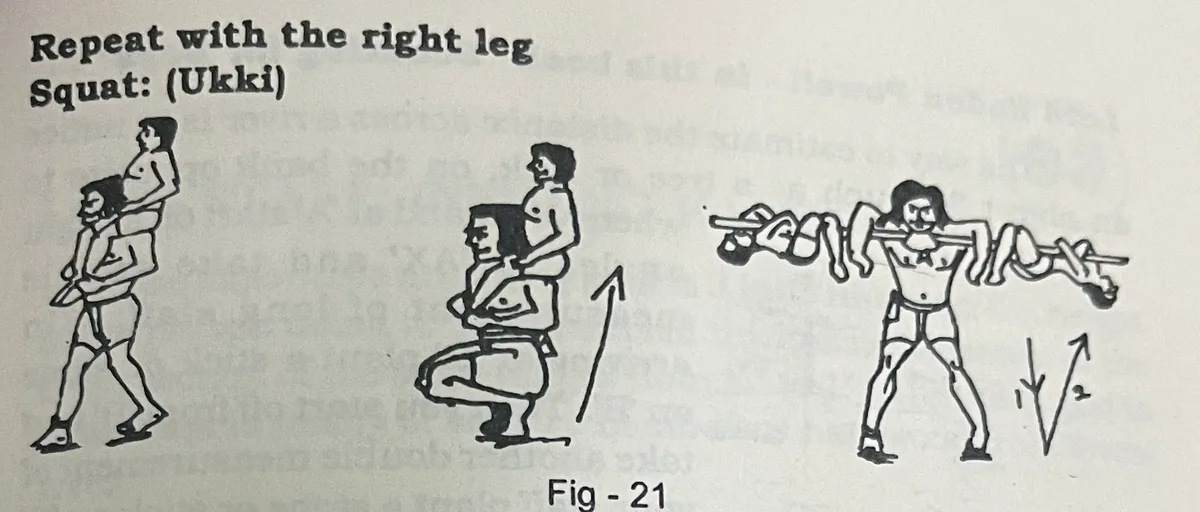 Ukki, the squat — Fig. 21 of A. Arunachalam's Silambam
A. Arunachalam gives a precise standard for the body Silambam requires:
Without getting any undue strain in one or both hands, one must be able either to feint or move the head, shoulder, hip and the portion below the waist at a time — or not to shake the above four parts — and thus maintain the whole body without any motion at another time, so as to cut, defend, thrust and sweep with marksmanship, skill, speed, and agility.
— A. Arunachalam, Silambam
MeiPadam begins by separating what ordinarily moves together so that the whole body may later move as one when necessary. The shoulder learns to turn while the hip stays quiet; the waist releases force while the head remains placed; then all four portions reunite for cut, defence, thrust and sweep. It teaches stillness inside movement and movement held ready inside stillness. Mei is the body and padam the lesson: the body learns its countless ways to move and repair before it is asked to fight.
The warning without undue strain is equally exact. Vasiṣṭha describes the suitable practice-bow as:
निजबाहुबलोन्मानात् किञ्चिदूनं शुभं धनुः ॥ ३० ॥
— वसिष्ठ धनुर्वेद संहिता १.३०
A bow a little under one's own arm-strength is the auspicious one: the instrument is fitted to the body, never the body strained to the instrument. The weight training involves introducing Karlakattai also known as Karela in Maharashtra, Mudgar or Mugdar in other parts of Bharat. The introduction is gradual as per the Shastras. The Mallapurana calls this मात्राशक्ति, the power of right measure, and keeps the yodha between the two losses: excessive labour on one side and abandonment of labour on the other. Enough weight to transform the body; enough measure to preserve its rhythm.
The first physical training, the śrama-abhyāsa has to be in the authentic sequence: MeiPadam's free body-lessons, TaraiPadam's work upon the ground such as ukki the squat, Kaal-Padam (foot-work & stances), and karla the rotation of a weighted club. After these comes the sequences and heavier Shrama-Abhyas.
The warming-up is essential and requires great suppleness — each movement repeated several times, facing north, east, south and west, till perfect loosening is achieved.
— A. Arunachalam, Silambam
At this stage the practitioner shouldn't think of perfecting hardest of the things but restoring the normal balance of nature. Think of the way our ancestors walked and moved through their daily chores; the way people who work hard — farmers, Gopalaks — carry themselves; the way they move swiftly around a floor in a squat; the way a child changes asana on the floor without thinking about it. Not just sitting comfortably in what we know as yoga asanas but moving and changing swiftly and sometimes with agility and bounce. Restoring the natural kinetic chains and compound coordinations. Working not just the muscles but also the fascia network, the tendons producing force through the stretch-reflex and moving fearlessly with high speed to the end of the range of motion. Not just repetitions restricted to 5 or 10 or 20 but 108 and 1008, moving until the movement dissolves, the neurons fire in a rhythm, moving along the least resistive path and heart pumping the blood and oxygen in abundance in the same rhythm. Restoring and rehabilitating any form of restriction. The spine is churning, the hands are not moving with shoulder muscles but with the momentum of balance shifting in legs, the twist is not just from spine but from the ankle to the knees. The neck can now look at the enemy at any point but still hands and legs can do their work as they have been trained to. Every part of a warrior has to have its own mind, it has to work aloof and still together for the task that it knows. It is a distributed machinery coordinated toward one single task without one master, like ants building an anthill. Here the anthill is the Dharma Yudha, not just a battle but the Swa-dharma of each of us. Are our body and mind ready for what it asks of us — the everyday hustle, the family, the festivals that come with no holiday, the extra work we pour in to pay our Ṛṣi-ṛṇa, for which the current system leaves no space at all? We are already bogged down and stressed, but with MeiPadam the mind becomes meditative. The everyday tensions dissolved, the focus is natural, not forced and not on an object but coming sahaj out of loss of vritti. The body adjusts and readjusts in weeks after weeks but when it finally settles, it has changed not just the Annamaya kosha — MeiPadam has nourished the Manomaya, Prāṇamaya, Vijñānamaya and Ānandamaya koshas too. That is MeiPadam. Different from any other paradigm, and the most practical thing there is for our own times.
Mallapurāṇa places Bhramaṇikā, Śvāsa-preraṇikābhyāsa, Āsthādanaka, Kuṇḍakāvartana, Goṇitaka and Gadābhyāsa among its sixteen śramas before naming Raṅgaśrama, the encounter itself (Mallapurāṇa ११.१–४२).
Karlakattai or Gada appears twice in this order. First as śrama, its rotations condition the grip, shoulders, spine, breath and chitta early. As gada or āyudha, its combat-karma arrive much later. One implement serves two stages of the vidyā, and the guru never confuses them. Similar to this the Nedu Kambu and Podi-kuchi have usage in initial exercises around MeiPadam but later they are also the Ayudh.
MeiPadam is not merely the external movement of the body. Each movement is joined to rhythmic breathing — Kshatriya Pranayama — because muscular strength without prāṇa cannot become enduring warrior-strength. Breath gives the movement its rhythm, the eye its steadiness and the chitta its wakefulness.
Vasiṣṭha Dhanurveda makes Svara Shastra part of victory itself:
जीवेन शस्त्रं बध्नीयाज्जीवेनैव विकासयेत् । जीवेन प्रक्षिपेच्छस्त्रं युद्धे जयति सर्वदा ॥ २९ ॥
— वसिष्ठ धनुर्वेद संहिता ३.२९
The breath binds the weapon, opens it and releases it. The quietest and least visible part of the act becomes the carrier of its most visible force. Kambu, hand and nāḍī cease to be three separate things; the strike travels upon the living current called jīva. The spectator hears the kambu cut the air; the practitioner feels that the sound began earlier, where breath turned inside the body.
This is why svara-abhyāsa runs beside śrama-abhyāsa from the first morning. Inhale and exhale are not decoration placed upon a finished technique; they are part of how the technique is learned. Victory first becomes possible within the pūrṇa-sattva-stha mind — steady in its own complete strength — before it appears on the field.
Vishvamitra shows the same order on the bank of the Sarayu. Though he possesses the divine astras and is taking Shri Rama toward battle, the first vidyā he gives is Balā and Atibalā:
मन्त्रग्रामं गृहाण त्वं बलामतिबलां तथा । न श्रमो न ज्वरो वा ते न रूपस्य विपर्ययः ॥ १३ ॥
— वाल्मीकि रामायण, बालकाण्ड २२.१३
Balā and Atibalā guard Shri Rama from fatigue, fever and the dimming of bodily lustre. Breath, endurance, wakefulness and bodily integrity enter before the astras because they are already Dhanurveda, not preparation outside it.
Integral Niyudha: From the kambu to Kuthu-Varisai
Niyuddha — in Tamil, Kuthu-Varisai — belongs within Silambam exactly as Bāhuyuddha belongs within Dhanurveda. Vasiṣṭha counts seven forms of yuddha and ends with the unarmed body in the same breath as the bow, chakra, kunta, khadga, churika and gada.
Kuthu-Varisai is called Empty-Hand Silambam, and like every name in this vidyā it is representative rather than exhaustive. Kuthu names the punch, the muṣṭi, while the field it stands for holds idi, the elbow; udai, the kick; vettu, the open-hand cut — the शक्ति मुद्रा, the hand carried as a blade, which the world now knows by the name of the karate chop; pidi, the grip; and pottu, the placing and the attack. With them come the head-butt, blocks made with hand, leg and head alike, locks, counters, throws and the breaking of an opponent's balance, and beyond them Muṣṭi-Yuddha and Malla-Yuddha.
The wider Adi-Thadi structure makes the division explicit: Kuthu-Varisai gathers the strikes, Thadu-Varisai the blocks, Pidi-Varisai the grips and throws, and Adi-Varisai reunites them at the final stage. Strike, defence and grappling are received distinctly and then made indivisible again, until the body no longer pauses to decide which category a movement belongs to.
Each strike, counter and grip is practised through its variations and through twelve angles, so a finite body of lessons opens into an unlimited number of attacks, defences and transitions. The animal forms give those combinations their quality — Tiger, Snake, Elephant, Eagle and Monkey, with the low, rooted Bear stance held in particular regard. The animal is not copied theatrically: its weight, its stillness, its alertness, its evasion or its sudden release is placed in the yodha's own body. At the advanced level Varma-Ati opens the locations and the angles of the १०८ वर्म points, so that power is joined to precision — and, in the complete vidyā, to Adangal, the knowledge of restoration.
The bridge from the kambu to the empty hand is Kaaladi. The same footwork that turns the staff supplies power to the blow; the same shift of weight drives a throw; the same waist and shoulder that guide the kambu guide the fist, the elbow and the open hand. The nilais, the turns, the weight-transfers and the breath all appear again with nothing in the hand.
So the lessons do not culminate in one beautiful sequence performed well. Their stated end is readiness against several armed opponents, where distance changes without warning and strike, block, grip, throw and movement must arrive as a single response. This is what Vasiṣṭha's list was saying from the beginning: when the kambu is gone, the grammar it taught remains, and the trained body is itself the final āyudha.
Murai and Varisai: a thousand styles, one signature
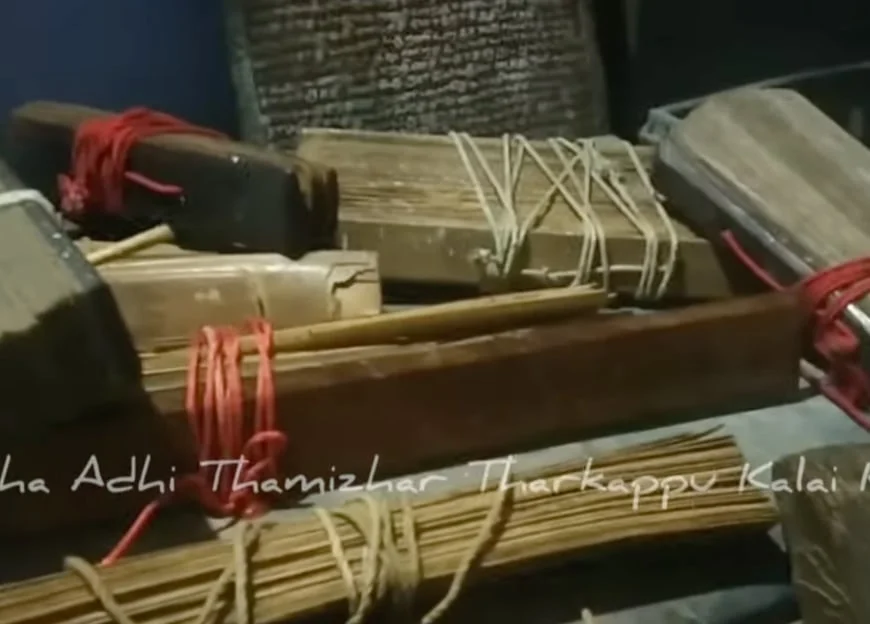 Pandulipi of Tamil sutra granthas on Marma, Silambam and more, kept by the generations of Shri Vengatraman Asan. pc: Shiva Asan
For every āyudha and every niyuddha there are several Murai — methods or styles — and Varisai — ordered sequences. Each is distinct, and each carries the unmistakable signature of the same vidyā. Some have flowed for generations through particular communities, kula and jāti, whose forefathers committed portions of the knowledge to manuscripts their descendants still keep as treasure richer than wealth. What one family guards in writing, another Guru carries in memory, another community preserves in its festivals, and another shishya receives through the movement of the body without a word being spoken.
Styles remember the land and the people through whom they travelled. Kuravanji remembers the Kurinji hill-country and its communities; Karnatakan and Karnataka Varisai carry their geography in their names; Therkkan and Vadakkan Chuvadu distinguish southern and northern footwork; Kallar Vilayattu and Kallan Kambu remember the Kallar stream. Beside them stand Panaiyeri Mallan, Naaga Paasanam, Minnal Vettu, Kida Muttu, Tomman Kuthu and Paarvai Vilayattu — names that preserve geography, community, occupation, animal movement, fighting temperament and the distinct insight of a guru-paramparā. The Naaga may look like nothing more than an animal movement, but the oldest memories of the Tamil country trace its people to the Nāga; and the Vānaras and Ṛkṣas of the Ramayana were the peoples of those forest regions, who carried in their bearing and their living the spirit of the bear and the monkey. To practise these styles well is still to take that spirit — those primal forces of nature — into the body.
Nadar, Thevar and Kallar are historic Tamil kula-jāti communities among whom different streams of Silambam, Adi-Murai and Varma knowledge have lived; across the old Travancore country the vidyā flowed also among the Ezhava and the Nair, meeting local forms without losing its earlier inheritance. So even Thekkan Kalari is not the name of one rigidly uniform style: from Kanyakumari through Trivandrum and Kollam it became a capacious name beneath which Agastya Adi-Murai streams and other local fighting systems continued in their own forms. One paramparā favours short, direct lines; another deep circular movement; one shows its distinction in footwork, another in grip, posture, angle, terrain or the length of the kambu. The differences are real, and so is the unity. Silambam does not preserve itself by making every Guru speak identically. It preserves itself by letting one ancient movement-grammar speak naturally through every land and every community that has lived it.
Concerns & Fear of a Parampara
The communities and Asans take pride in that inheritance, and they are often hesitant to carry it past the boundary of their own kula. The reasons are not imagined. They remember the times they trusted and were robbed. They remember the same arts that are prayer to the Devatas inside a temple being turned on that temple to raze it as but-parasti. They remember the British poisoning the Asans and banning the arts outright. Most of these warrior clans never found their due afterwards: many are classed today as scheduled caste, scheduled tribe or backward, and named आदिवासी — old-inheritors — as though everyone else had arrived new, with no jāti, no kula and no ancestors of their own.
Their arts have no standing in the present system. Asans who carry an entire ancestral vidyā in their bodies do menial work for a living and find few takers. Recognition, when it comes at all, tends to arrive sideways — from a foreigner hunting a gimmick and an audience for a social-media account, or a con-guru looking for a fresh pitch now that the sales of his transformation plan are falling.
So the fears of the guru-paramparā are still sound, and the danger is no longer only the stray practitioner who will misuse a technique. Social-media heroes teach moves they never received from any Guru, assembled from whatever lies open, unstructured and misappropriated. The usual suspects arrive with their supremacy intact, bow before an akhara for the camera, learn a little, and are doing post-modernism by the afternoon. And the meek desi, the brown sepoy with his convent school curriculum still in his veins, runs for the white man's acknowledgement and queues for an autograph on his Mudgar. They commit every wrong modern fitness has to offer, then use the āyudha as a prop for reels and a niche community, exactly as the marketing man advised.
And yet, by the grace of Ādi-Guru Shiva and the karuṇā of living Gurus who opened their hearts and placed their trust in us, several of these styles and knowledge-systems continue to be taught to worthy students, while foundational practice such as MeiPadam is given openly for the good of society. That is what makes it more urgent, not less, for Dharmik people to resolve to practise these arts and to teach them to the best of their capacity. Our simplest and most powerful Dharmaśāstra, the Panchatantra and the Hitopadesha, put it plainly:
विद्या विवादाय धनं मदाय शक्तिः परेषां परपीडनाय। खलस्य साधोः विपरीतमेतद् ज्ञानाय दानाय च रक्षणाय॥ An ill minded person uses knowledge, money and power to argue, show off, and oppress others, a Sadhu person uses those to share, do Danam (दानम्) and protect the weak.
Silambam & its Dhanurveda siblings: Itihasa ties the World
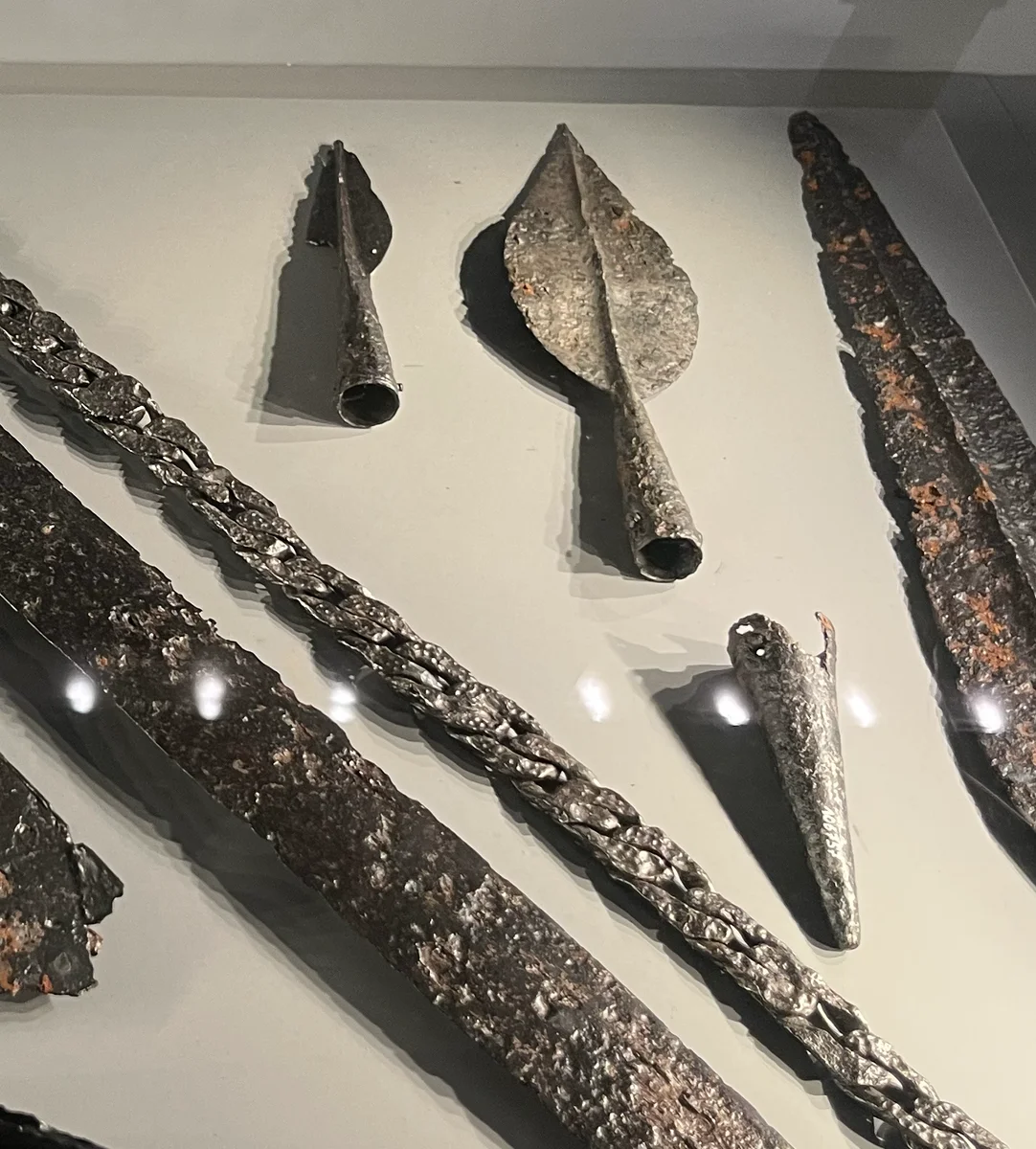 Iron weapons offered at a Celtic sanctuary — Lower Austria, later Iron Age
In a museum case in Vienna lie iron weapons laid down as offerings — spear butts, sword fragments bent before burial, scabbards nailed open for display. The same kinds of artifact that turn up in excavations across Bharat.
Set it beside what has come out of the ground at Sinauli near Hastinapur (think Mahabharata) or Keeladi, Sivaganga (think Velu-Nachiyar or Marutha Bandhu). The Bharatiya finds are older — Mahabharata times, and sites running back to 4000 BCE and beyond — and the metallurgy is not the same either. And yet the leaf is the same leaf, the resemblance is uncanny, the blade set on the haft in the same proportion. Anyone who has held a Vel would name it without being told.
How far that metallurgy actually went is not a matter of opinion. In 2020 a team publishing in Scientific Reports put the glossy black coating of pottery sherds from Keeladi under an electron microscope and found multi-walled carbon nanotubes and layered graphene worked into it — laid down in the sixth century BC, and still adherent, still stable, after twenty-six centuries in the ground. They are the oldest human-made nanostructures identified anywhere on earth.
Fourteen years before that, a group at Dresden had done the same to a seventeenth-century Damascus sabre and found carbon nanotubes again, with cementite nanowires running through the steel. Damascus blades were forged from wootz — the high-carbon crucible steel of the Dakshin, made in Tamil and Telugu country and carried west for centuries to be sold.
The pot and the sword are not one object and were not made by one pair of hands. What they share is a command of carbon at high temperature whose method we have still not reconstructed — in one country, across the same span of centuries.
Kokarneswaran et al., "Discovery of carbon nanotubes in sixth century BC potteries from Keeladi, India", Scientific Reports 10:19786 (2020) · Reibold et al., "Carbon nanotubes in an ancient Damascus sabre", Nature 444:286 (2006).
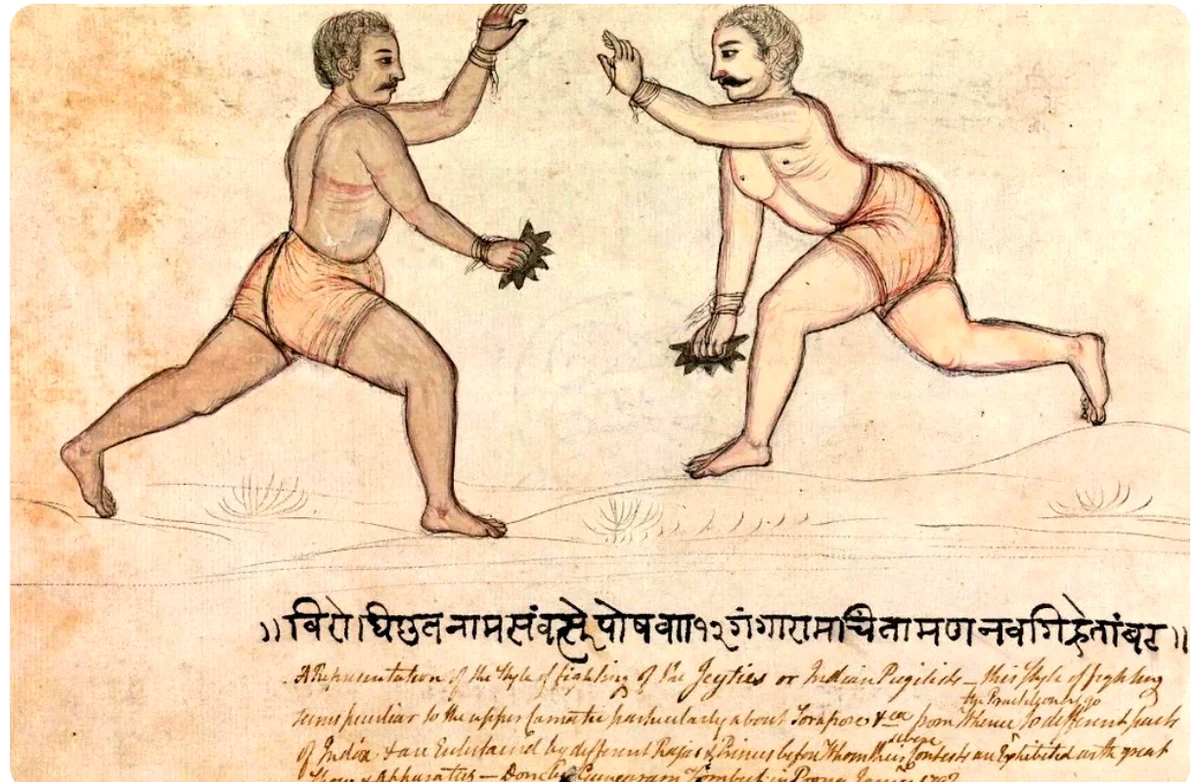 Jethi (ज्येष्ठी) fighting with the वज्र-मुष्टि in the same spirit as the famous Malla-yudha of Mahabharata times — painted at Poona, January 1792
Two centuries ago at Poona someone painted a pair of Jethi — ज्येष्ठी, the very class the मल्लपुराण ranks at its summit — set against each other with the वज्र-मुष्टि, the horned knuckle gripped in the closed fist. The hand that inscribed it dated the sheet January 1792.
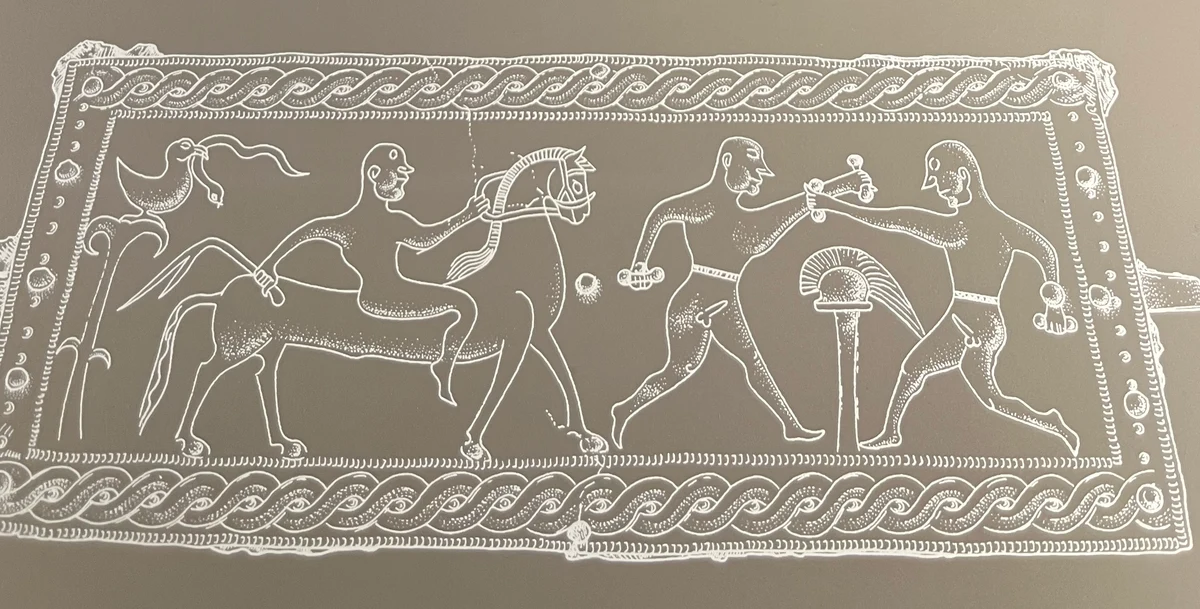 The plate drawn out — two boxers, a grip in each fist. Bronze belt-plate, Brezje, Slovenia, c. 500–400 BC
And on a bronze belt-plate from Brezje in Slovenia, worked somewhere around 500–400 BC, two men stand in that same lunge, something gripped in each fist, a crested helmet set between them for the winner to take.
Neither picture settles anything, but they raise one question that we set out to settle. The आयुध and the नियुद्ध we have been tracing back to a single root — is it in any way related to the warriors and their physical culture around the world? The Sanatana Dharma civilisation of arts, of craft and of kāla reached far past the borders we now draw for it, and the reach left objects behind. Today we read that map the other way round — East set against West, with the Yavana, the Huns, and the शक of उत्तर कुरु (Rus) standing outside it as strangers.
What is the relationship of Silambam with the arts of China and Japan, and with the Vikings and the Greeks? Let us go back and dig deep. This is hidden behind a lot of false notions spread during the modern literature writing done with propaganda, so it will take some space and some challenges — but the picture behind that dust is as clear and consistent as nothing else is. Unless we know the warrior Vansh (clans) of the past as they were, we will not understand the relationship of Silambam and the staff in Karate, the Meels of Persia and the Karlakattai of Silambam.
Dravid Shiromani Manu Maharaj, Cholas & Pandyas
The Cholas opened their copperplates — Kanyakumari, Tiruvalangadu and Anaimangalam — with Brahmā, Marīci, Kaśyapa and Vaivasvata Manu, carried the line through Ikṣvāku, Hariścandra, Sagara and Bhagīratha, sang of Shri Rama, and then arrived at a king named Chola. Their titles remembered the same inheritance: Manu-Nīti Cholan, the Chola who upheld Manu's justice even against his own son, and Sembiyan, from Shibi, the king who gave his own flesh to save the dove.
The Pandyas traced their line through the Chandravansha, from the Moon and Ila through Budha, Purūravas and Nahuṣa, and received Murugan as Ugra-Pāṇḍya within their own house. The Pallavas traced their line to Bharadvāja, whose paramparā gave Dhanurveda the great Acharya Drona.
The Rāmāyaṇa names the Colas, Pāṇḍyas and Keralas as established kingdoms of fierce warriors; the Bhāgavata knows Gajendra as a Pāṇḍya king of Draviḍa. At Yudhiṣṭhira's Rājasūya the Cholas and Pāṇḍyas come among the organised southern kingdoms bearing tribute — pearls, sandalwood, embroidered cloth and vessels of gold. On the field at Kurukṣetra the Pāṇḍya king Sarvadhvaja or Malayadhvaja, fought for the Pāṇḍavas as a great chariot-warrior, withstanding Droṇa's celestial weapons and cutting down Kaurava warriors before he falls.
The Srimad Bhagavatam places the source still more clearly:
योऽसौ सत्यव्रतो नाम राजर्षिर्द्रविडेश्वरः । ज्ञानं योऽतीतकल्पान्ते लेभे पुरुषसेवया ॥ २ ॥ स वै विवस्वतः पुत्रो मनुरासीदिति श्रुतम् । त्वत्तस्तस्य सुताः प्रोक्ता इक्ष्वाकुप्रमुखा नृपाः ॥ ३ ॥
— श्रीमद्भागवतम् ९.१.२–३
The rājarṣi of the Dravida country receives knowledge through service to the Original Person and rises as Vaivasvata Manu. From him comes Ikṣvāku; from Ikṣvāku, the Suryavansha of Ayodhya and Shri Rama. The Silambam country stands at the source of this stream and carries it forward.
That is the ground the art stands on. From these houses the vidyā went outward in every direction, and the eastern passage is the one to follow first.
Bodhidharma of India, the founder of Zen Buddhism, taught the Chinese this art as Shaolin Boxing. It then passed on to Japan to blossom into the art of the empty hand — Karate… Bodhidharma had introduced the bare-hand fighting techniques called Verum Kai Adimuraigal, which are still practised in Tirunelveli and Kanyakumari.
— A. Arunachalam, Silambam
On the same eastern passage, Arunachalam quotes François Gautier writing in The Hindu:
Shaolin Boxing and Zen Buddhism travelled from China to Japan, landing in Okinawa, where Kalari-payat became the art of empty hands — Karate.
— François Gautier, The Hindu, 12 May 1985, quoted in A. Arunachalam, Silambam
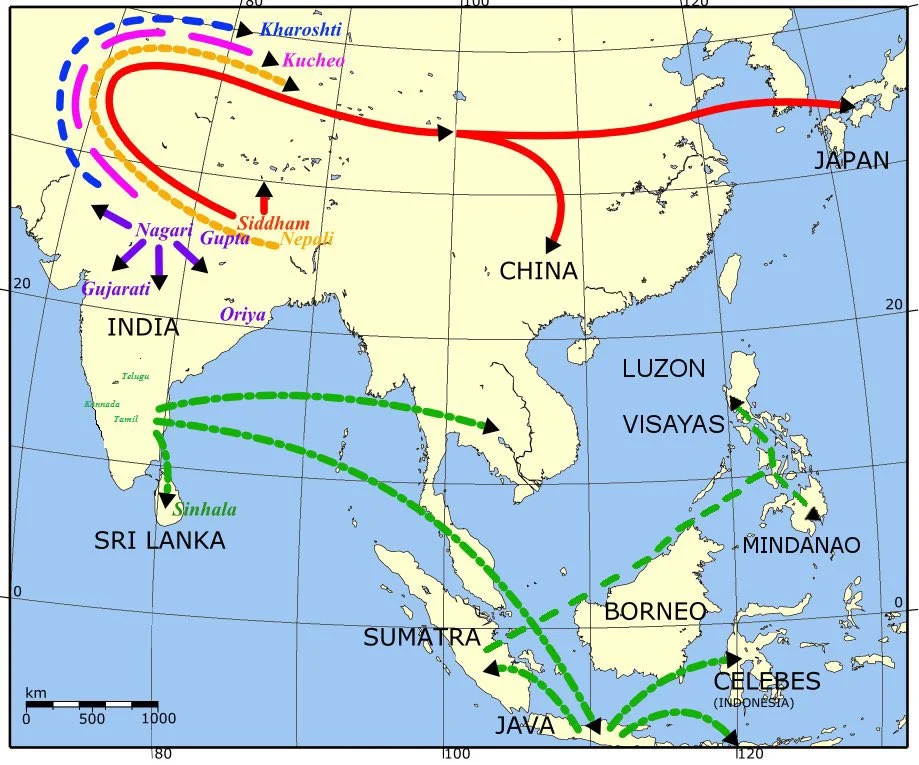 The Brahmi-descended scripts leaving Bharat — north through Kharoshti, Gupta and Siddham to China and Japan, and south by sea from the Tamil country into Lanka, Sumatra, Java and the islands beyond. The vidyā travelled the same two passages.
Verum Kai, the empty hand, sails east with Bodhidharma. In China it flowers at Shaolin; in Japan its name becomes Karate, 空手, the empty hand once more. In Tirunelveli and Kanyakumari the same niyuddha field continues as Kuthu-Varisai.
And the circle does not stop at the present borders of Tamil Nadu. Kalaripayattu across Kerala, Angampora in Lanka, and the staff and empty-hand systems carried into the Malay world—where they flowered through Bersilat and Pencak Silat—may look increasingly different as the sea, forest, hill, weapon, clothing and battlefield change; yet they are not sealed, unrelated inventions. The deep stance and sudden leap, the animal-form, the turning waist, the empty hand that first learns the path of the weapon, the joining of strike, block, grip and throw, the knowledge of vital points inseparable from healing, and the final demand that one warrior face many—all disclose the same greater grammar. Their differences are real, just as Tamil, Malayalam, Sinhala and Malay are real languages; but difference of language does not mean absence of relation. What appears from afar as many separate martial arts is, from within, one ancient ocean of Dhanurveda entering different lands, receiving their colour and returning under many names without losing its rasa.
The river of knowledge was never one-directional. The lands now placed outside Bharat were connected through vaṃśa, movement, estrangement and return. To understand the western flow, we have to first understand how our distant brothers and sisters on the western side are connected with the same root.
Iran took the name for the people who follow the principles of Dharma, Arya. The word Iran means the land of the Aryas. The Persian language, the Persian religion, and the Persian political system (known as Parsik in Bharatiye Itihasa) all bear a Vedic signature so unmistakable. Persia’s ancient name was Elam, a variation of Ila, the Sanskrit sacred land.
The Germanic and Slavic pulse moved overland from the ninth millennium BC. They carried the sky-father Dyaius, who became Tyr in Scandinavia, Zeus in Greece, Deus in Rome. The Italo-Celtic pulse moved by sea from the seventh millennium. The Greeks came in the same window. Zeus is Dyaius. When Alexander crossed the Hindu Kush he met people at Nysa claiming descent from Dionysus. Some of their heroes, they said, had come this way.
Vedic Dyaius daylight-sky god *Dyēus, and is cognate with the Greek Διας – Zeus Patēr, or Dei-pátrous, and Latin Jupiter (from Old Latin Dies piter Djous patēr). The oldest surviving Irish text, the Book of Invasions, records a tribe called the Erainn, from Arya, arriving from the south by sea and making their way inland to the sacred Hill of Tara.
Danu is the Rig Veda mother goddess of the flowing waters. Her name is written into the geography of half of Eurasia. The Danube. The Dniester. The Dnieper. The Don. The Donau. Greek Demeter. Northern Greeks once called themselves the Dannuni. In Ireland, the pre-Christian pantheon called itself the Tuatha de Danaan. Children of Danu. — Excerpts taken from Nick Collins' Maritime Trade History
The phased emigration from Bharat is well recorded in all of our Shastras. Ancient Bharat and the regions now considered foreign were not always alien to Sanatana Dharma. The यवन (Yavan), शक (Shak), हूण (Hun), पह्लव (Pahlav), and कम्बोज (Kamboj) moved outward in different periods, established kingdoms, and passed through phases of estrangement and reconnection. Sometimes grouped as the पञ्चगण (Panchagaṇa), they appear in the Vedas, the Ramayana, the Mahabharata, the Smritis, and the Puranas—often remembered as Kshatriyas whose adherence to Dharma declined over time.
Our texts record the earliest roots of this outward migration. According to the Mahabharata and the विष्णुपुराण (Viṣṇupurāṇa 4.10), King ययाति (Yayāti) gave the directions of the earth to his five sons: यदु (Yadu) and तुर्वसु (Turvasu) by देवयानी (Devayānī), and द्रुह्यु (Druhyu), अनु (Anu), and पुरु (Puru) by शर्मीष्ठा (Sharmiṣṭhā). Four were sent to rule the outer regions, and the descendants of तुर्वसु came to be known as the यवन (Yavanas). Thus, in Puranic genealogy, the Yavanas share the same Aila (Chandravanshi) lineage as the Pandavas and the Pandyas. Echoes of this ancient connection survive even today: the Greeks still call themselves Ionian (closely related to यवन) or Hellen (sons of Ila).
Consequently, the Mahabharata world extended far beyond the geography of current India, although the Rashtra—defined by cultural integration—still exists in one form or another, often living on in the warrior and physical arts. गान्धार (Gandhar) was Duryodhana's maternal homeland. बाह्लीक (Bahalik), brother of Shantanu and ruler of current Bactria (named after Bahlik), remained deeply involved in the Hastinapur events, including the war. Farther west, the Pahlavas were associated with the worship of Shiva, Surya, and Agni. The dynasties later categorized as Indo-Greek, Indo-Scythian, and Indo-Parthian were therefore not simply foreign powers standing outside Bharatiya civilisation. 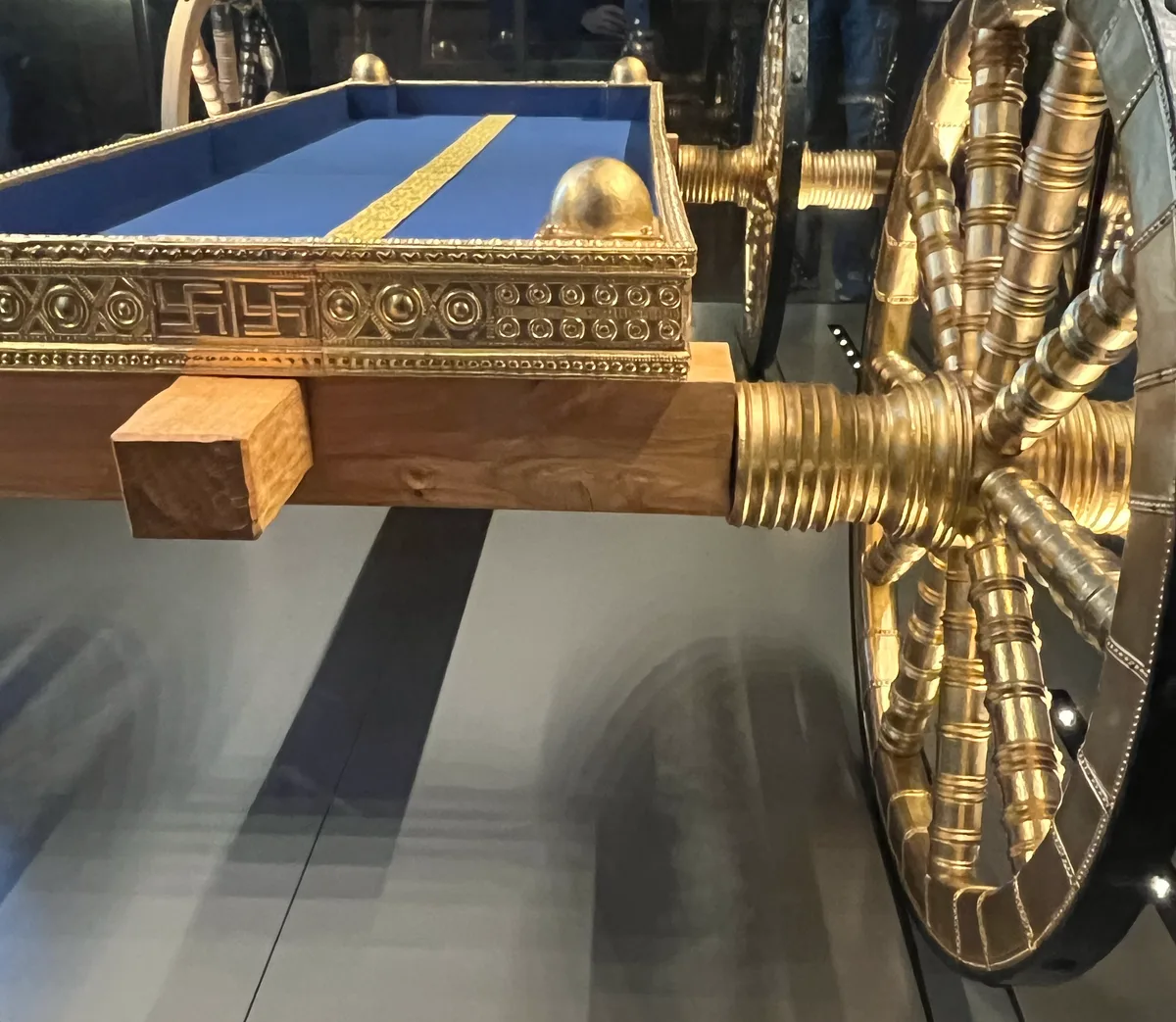 Ceremonial wagon from the Býčí Skála cave in Moravia — Celt Vansh, 5th century BC showing Swastika, currently kept in Austria Museum.
Farther west still, peoples such as the Celts utilized sacred symbols resembling the swastika and prayed to Devatas they remembered from their ancestral heritage. They were not savages and they were not barbarians; those words were supplied afterwards, by people with an interest in the telling. They had their Devatas, their reverence for the river and the forest, and a warrior code of their own. What was lost there is not the inheritance but the name of it — and the names are still lying about in the open, written across the rivers of half of Eurasia, waiting for someone to read them again.
This deep Mahabharata imprint continued to echo through the names of rulers, regions, and practices generations later. The oldest surviving manual of horse-training outside Bharat's present borders belongs to the मित्राणि (Mitanni)—a people of Hurrian (हरि) stock. Strikingly, it counts its exercises in our own numerals: aika-vartana, tera-vartana, panza-vartana, satta-vartana, nava-vartana (एक, त्रि, पञ्च, सप्त, नव वर्तन—one, three, five, seven, and nine turns). Their king was तुष्रत्त (Dashratha), and the gods by whom they swore their treaties were the Vedic deities मित्र (Mitra), वरुण (Varuṇa), इन्द्र (Indra), and the नासत्य (Nāsatya).
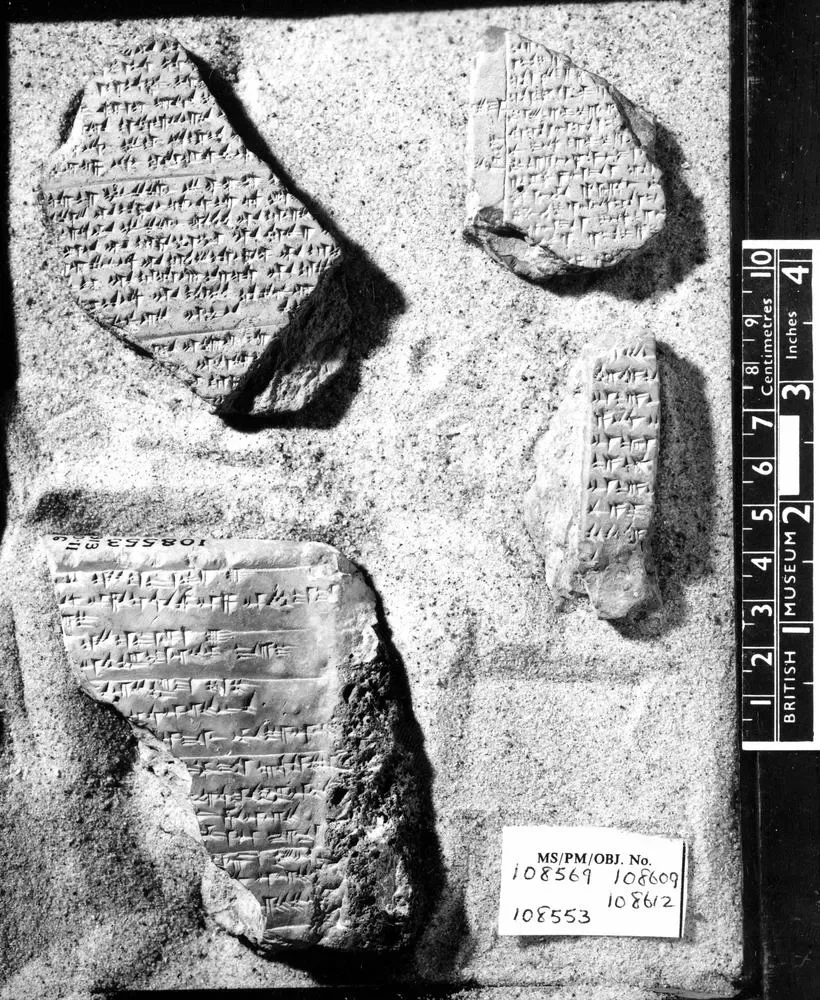 Cuneiform tablet fragments — British Museum, object nos. 108553, 108569, 108609, 108612
Similarly, the great Parsik emperor known to the West by the Greek exonym "Cyrus" actually referred to himself in his own cuneiform inscriptions by the endonym Kūruš—a direct reflection of the ancient कुरु (Kuru) lineage. His son and successor, Cambyses, bears the Old Parsik name Kambūjiya, intimately tying back to the ancient कम्बोज (Kamboja) people. This linguistic and cultural legacy later traveled as far as Southeast Asia to name modern-day Cambodia (Kambuja-desha). Despite this shared heritage, conflicts arose. Generations after Yayāti, when King सगर (Sagara) of the Surya Vansh defeated the शक (Shakas), यवन (Yavanas), कम्बोज (Kambojas), पारद (Paradas), and पह्लव (Pahlavas), he prepared to annihilate them entirely. Seeking refuge, the vanquished tribes went to the Brahmarṣi वसिष्ठ (Vasiṣṭha). The great sage restrained the king; he ensured their lives were preserved, though their customs were changed. The oldest textual layer of this tribal memory appears in the दाशराज्ञ (Dāśarājña), the Battle of the Ten Kings, in the seventh Mandala of the ऋग्वेद (Rigveda), authored by Brahmarṣi Vasiṣṭha himself:
पुरोळा इत्तुर्वशो यक्षुरासीद्राये मत्स्यासो निशिता अपीव । श्रुष्टिं चक्रुर्भृगवो द्रुह्यवश्च सखा सखायमतरद्विषूचोः ॥ ६ ॥ आ पक्थासो भलानसो भनन्तालिनासो विषाणिनः शिवासः । आ योऽनयत्सधमा आर्यस्य गव्या तृत्सुभ्यो अजगन्युधा नॄन् ॥ ७ ॥ *— ऋग्वेद ७.१८ *
Among the confederacy names recorded here are तुर्वश (Turvaśa), द्रुह्यु (Druhyu), अनु (Anu), पूरु (Puru), तृत्सु (Tritsu), मत्स्य (Matsya), भृगु (Bhṛgu), पक्थ (Paktha), भलानस (Bhalānasa), आलिन (Alina), विषाणिन् (Viṣāṇin), and शिव (Shiva).
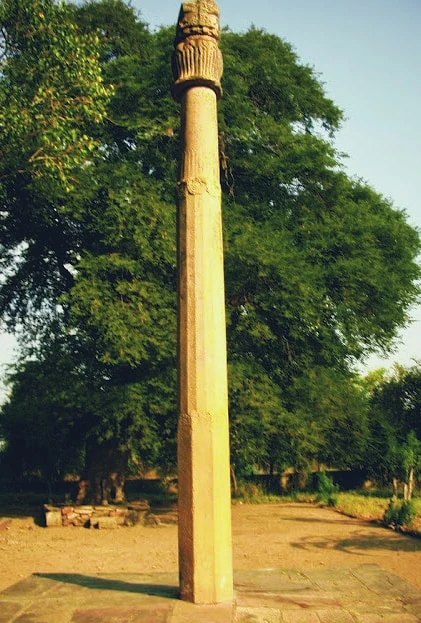 The Heliodorus pillar at Vidishā, Madhya Pradesh
At Besnagar near Vidisha, this civilisational field stands in stone. Heliodorus (हेलिओदोरोस meaning: Surya/Hari Datta), son of Dion (from Dyaus/द्यौस्), a native of Takshashila and ambassador of the Yavana king Antialcidas (अन्तिअल्कि दास), raised a Garuda-dhvaja to Vāsudeva, and called himself a Bhāgavata. He did not stop being a Yavana in order to do it. Upon its other face, he placed three amṛta-pada:
दम — self-restraint · त्याग — relinquishment · अप्रमाद — unbroken vigilance
These are also the virtues as illustrated in our Dharma Shastra. Dama governs force. Tyāga removes selfish possession of vidyā. Apramāda is the attention that cannot lapse while an āyudha is in motion.
The pillar still stands. (The divisions of āyudha and the question of who is fit to receive them are taken up at greater length in Understanding Dhanurved.) This can indicate why the same arts, same principles are still as valid as always. But the practice has more to offer if we look closely.
फलश्रुति: what the practice gives
A renowned Tamil classic, the Padhaartha Gunasindhaamani, places Silambam in a complete warrior curriculum:
Silambam mudhal malyudhdham; yaanai aetram, kudhirai aetram; dhesi, nadai kollin; vaadham pōm, vaayu pōm, kabam pōm; thulangu pasi undaagum.
— पदार्थ गुणसिन्धामणि, quoted in A. Arunachalam, Silambam
Silambam leads into Malla-Yuddha, then into battles fought mounted on the elephant and the horse. Vāta settles, cold and kapha depart, agni brightens and hunger becomes clear. The warrior curriculum ripens into the language of Ayurveda because it has been training the whole person from the beginning.
Another Silambam song begins with ukki, the squat, and promises that through daily practice the shoulders and legs will become established. The training-order and its fruit are joined: what the song promises is produced by what the student actually repeats. But remember these are narrow, short sighted checkpoints in the big expanse of DharmaShastra.
The Mallapurana states the goals that one gets by practicing Dhanurveda arts as follows:
सर्वकामप्रदा ह्येषा सर्वलोकाभिमोहिनी । अनया साध्यते धर्मः कामः सम्यगवाप्यते ॥ १५ ॥ मोक्षोऽपि प्राप्यतेऽभ्यासात् मदभ्यस्ता पुरा यतैः । ममाङ्गसंस्थितां विद्यां धारयिष्यन्ति भूतले ॥ १६ ॥
— मल्लपुराण २.१५–१६
The body ripens into a bearer of all four puruṣārthas. Dharma is accomplished; artha (money) is sustained; kāma (Shubhecha; desires for greater good bound by Vivek and Dharma) is rightly obtained; mokṣa opens through ultimate fearlessness that guides relentless work for Dharma, as it did for the yatis (our great ancestors) who practised this vidyā in earlier times. This reminds us again that the Dharmik people should strive hardest to gain money and power with no restraint with the knowledge of Moksha in their heart so that they can establish Dharma for the Kalyan (good) of every being in all Loka.
Such victory requires a body whose every dhātu has ripened through abhyāsa:
प्रधानं सर्वविद्यानां यया वृत्तिर्न जायते । पच्यते सर्वधातुश्च मल्लविद्याविधारणात् ॥ १२ ॥
— मल्लपुराण २.१२
Rasa, rakta, māṃsa, meda, asthi, majjā and shukra mature as Malla-Vidyā is held in the body. These are not incidental health-benefits around the edge of the subject. This is the body Dharma requires the yodha to build.
Let us see the आत्यन्तिक or ultimate goal from वशिष्ठ धनुर्वेद:
हिताय गोब्राह्मणसाधुवेदसंरक्षणाय च यजुर्वेदाथर्व सम्मितां संहिताम्। ब्राह्मणार्थे गवार्थे वा स्त्रीणां बालवधेषु च। प्राणात्यामपरो यस्तु सवै मोक्षमवान्पुयात्। ६६
The protection of cow, brahmin, dharmik people, women and kids is the aim of Upaveda of yajurveda i.e. Dhanurveda. Thus, walking this path one leads to Moksha. *- वशिष्ठ धनुर्वेद *
Moksha is synonymous to ultimate fearlessness, even from death and thus walking as per Dharma. This is same as a quality of a true warrior as exemplified by Shri Ram to Maharana to Lachit Borphukan to Gokula Jat or Alluri Sitarama Raju and countless more who walk the path of Dharma as exemplified by them.
This is the phalaśruti of the Murugan-Agastya stream: victory of Dharma over Adharma, a body and prāṇa prepared to carry that victory, and a vidyā transmitted through reverence, measure and relentless practice. It is why the kambu is still placed in a five-year-old's hands on an akhara floor and why the same lesson continues to deepen in the hands of an Asan.
The staff selected like a musical instrument becomes the instrument upon which a whole life of Dharma can be played.
योगः कर्मसु कौशलम् ।
— श्रीमद्भगवद्गीता २.५०
Continue
Read this next
The Famous Five & the Idumban Karlakattai
The Famous Five & the Idumban Karlakattai
Read
Understanding Dhanurved: Chapter-1
Understanding Dhanurved: Chapter-1
Read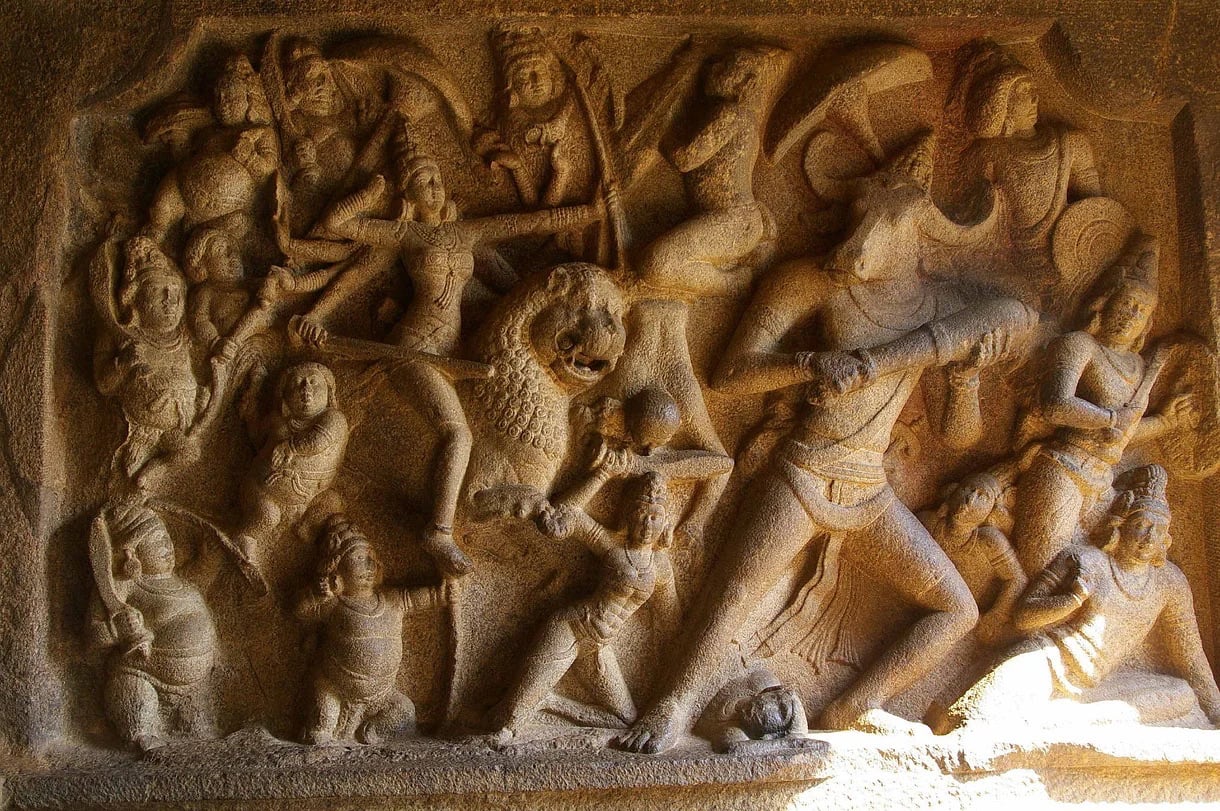
Podi-Kuchi, an essential in Bhartiye Fitness
Podi-Kuchi, an essential in Bhartiye Fitness
ReadComments
Commenting as a guest. Log in to reply, react to comments and keep your name.
No comments yet. Be the first to share your thoughts!
'%3e%3ccircle%20cx='430.943'%20cy='430.943'%20r='156.943'%20fill='white'/%3e%3c/g%3e%3cdefs%3e%3cfilter%20id='filter0_f'%20x='0'%20y='0'%20width='861.886'%20height='861.886'%20filterUnits='userSpaceOnUse'%20color-interpolation-filters='sRGB'%3e%3cfeFlood%20flood-opacity='0'%20result='BackgroundImageFix'/%3e%3cfeBlend%20mode='normal'%20in='SourceGraphic'%20in2='BackgroundImageFix'%20result='shape'/%3e%3cfeGaussianBlur%20stdDeviation='137'%20result='effect1_foregroundBlur'/%3e%3c/filter%3e%3c/defs%3e%3c/svg%3e)
'%3e%3ccircle%20cx='384'%20cy='384.5'%20r='110'%20fill='%232F7AF9'/%3e%3c/g%3e%3cdefs%3e%3cfilter%20id='filter0_f'%20x='-0.000488281'%20y='0.499756'%20width='768'%20height='768'%20filterUnits='userSpaceOnUse'%20color-interpolation-filters='sRGB'%3e%3cfeFlood%20flood-opacity='0'%20result='BackgroundImageFix'/%3e%3cfeBlend%20mode='normal'%20in='SourceGraphic'%20in2='BackgroundImageFix'%20result='shape'/%3e%3cfeGaussianBlur%20stdDeviation='137'%20result='effect1_foregroundBlur'/%3e%3c/filter%3e%3c/defs%3e%3c/svg%3e)
'%20stroke='white'/%3e%3c/svg%3e)
All rights reserved © Karla Kutuhal Akhara by Vagambhrini 2021-2026
UDYAM ID: UDYAM-UK-07-0005613 | MSME Registered under 8541 - Sports Education
'%3e%3c/g%3e%3c/svg%3e)
'%3e%3c/g%3e%3c/svg%3e)

'%3e%3cpath%20id='path7'%20fill='%23282828'%20fill-opacity='1'%20d='M118.9%2013.3c-1.4-5.2-5.5-9.3-10.7-10.7C98.7%200%2060.7%200%2060.7%200s-38%200-47.5%202.5C8.1%203.9%203.9%208.1%202.5%2013.3%200%2022.8%200%2042.5%200%2042.5s0%2019.8%202.5%2029.2C3.9%2076.9%208%2081%2013.2%2082.4%2022.8%2085%2060.7%2085%2060.7%2085s38%200%2047.5-2.5c5.2-1.4%209.3-5.5%2010.7-10.7%202.5-9.5%202.5-29.2%202.5-29.2s.1-19.8-2.5-29.3z'/%3e%3cpath%20id='polygon9'%20fill='%23fff'%20d='M80.2%2042.5%2048.6%2024.3v36.4z'/%3e%3c/g%3e%3c/svg%3e)